

Claim Estimation
Predictive Claim Estimation That Drives Upfront Payments
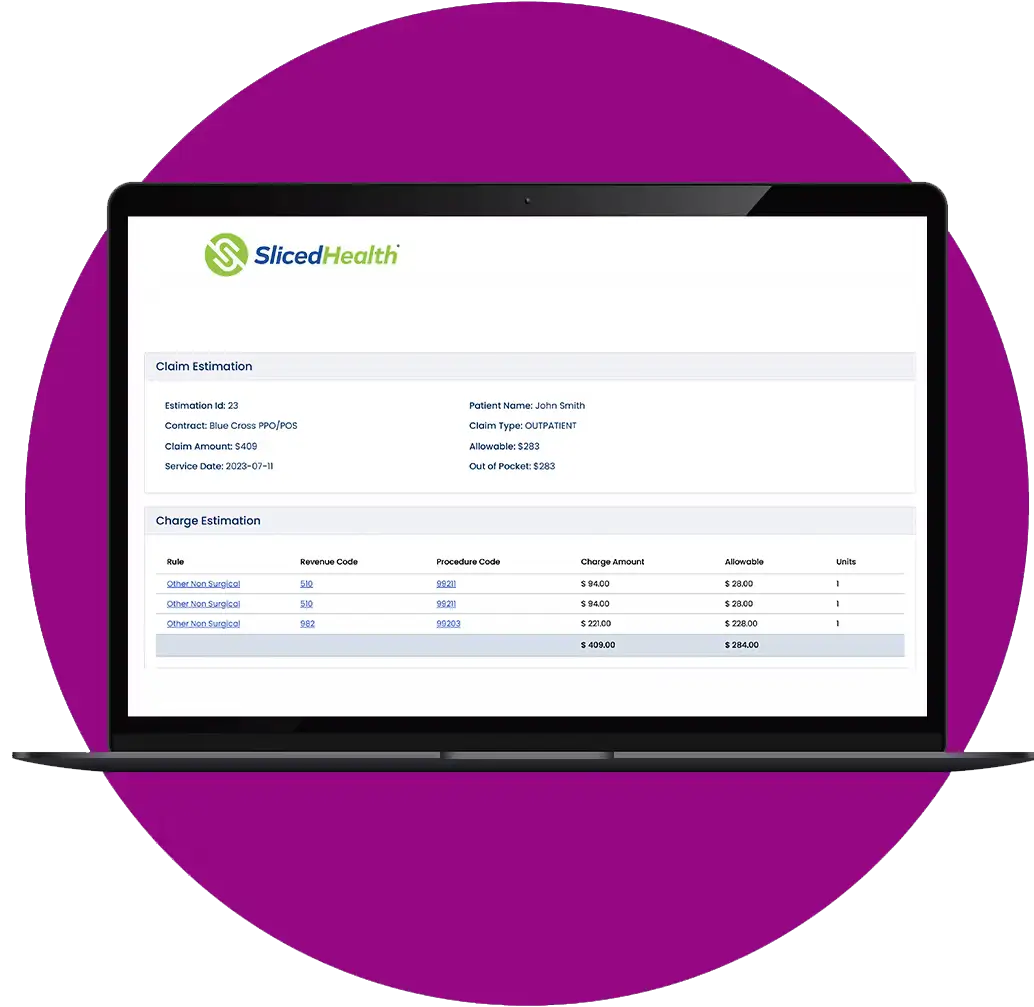
SlicedHealth Claim Estimation gives healthcare organizations a clearer view of expected reimbursement before services are rendered. By combining real claims data with intelligent modeling, we help providers estimate patient responsibility more accurately, increase upfront collections, and reduce financial uncertainty.
Built to support modern reimbursement strategies, Claim Estimation works alongside contract management and price transparency to strengthen revenue performance without adding operational complexity.
For more information about our Claim Estimation solution please Download Brochure
We've got you covered!
Enabling upfront payments can mitigate financial loss for your organization and increase patient satisfaction, thus reducing the likelihood of patient leakage. Patient satisfaction hinges on providing a transparent understanding of financial obligations before healthcare services are rendered. Estimating the customer’s portion and the overall claim payment status has become monumentally important to both patients and organizations.
Claim Estimation uses contract intelligence to generate estimates based on how reimbursement is actually determined. This enables teams to validate expectations before services are delivered and maintain alignment across pricing, billing, and financial performance.
Estimate
Establish accurate expectations before care is delivered.
- Generate reliable estimates using real contract and reimbursement data
- Clearly define patient responsibility and expected payer reimbursement
- Support upfront financial conversations with confidence
Validate
Ensure estimates align with contract terms and real performance.
- Apply healthcare reimbursement modeling informed by historical outcomes
- Account for payer rules, contract structures, and compliance requirements
- Reduce gaps between estimated and actual reimbursement
Collect
Turn accurate estimates into improved financial results.
- Increase upfront collections while reducing downstream corrections
- Minimize underpayment risk tied to contract variability
- Strengthen financial performance across service lines, including rural healthcare contracts
Claim Estimation integrates with clearinghouses and billing systems to reduce underpayment risks, improve upfront collections, strengthen patient satisfaction, create estimates before care is delivered, and guarantee Transparency in Coverage compliance.

Revenue You Can’t See is Revenue You’ll Never Collect – Let’s Talk
Missing revenue isn’t always obvious—but that doesn’t mean it’s lost. Let’s start the conversation. Fill out the form, and our team will be in touch.